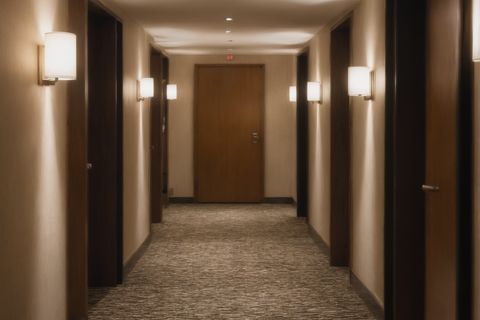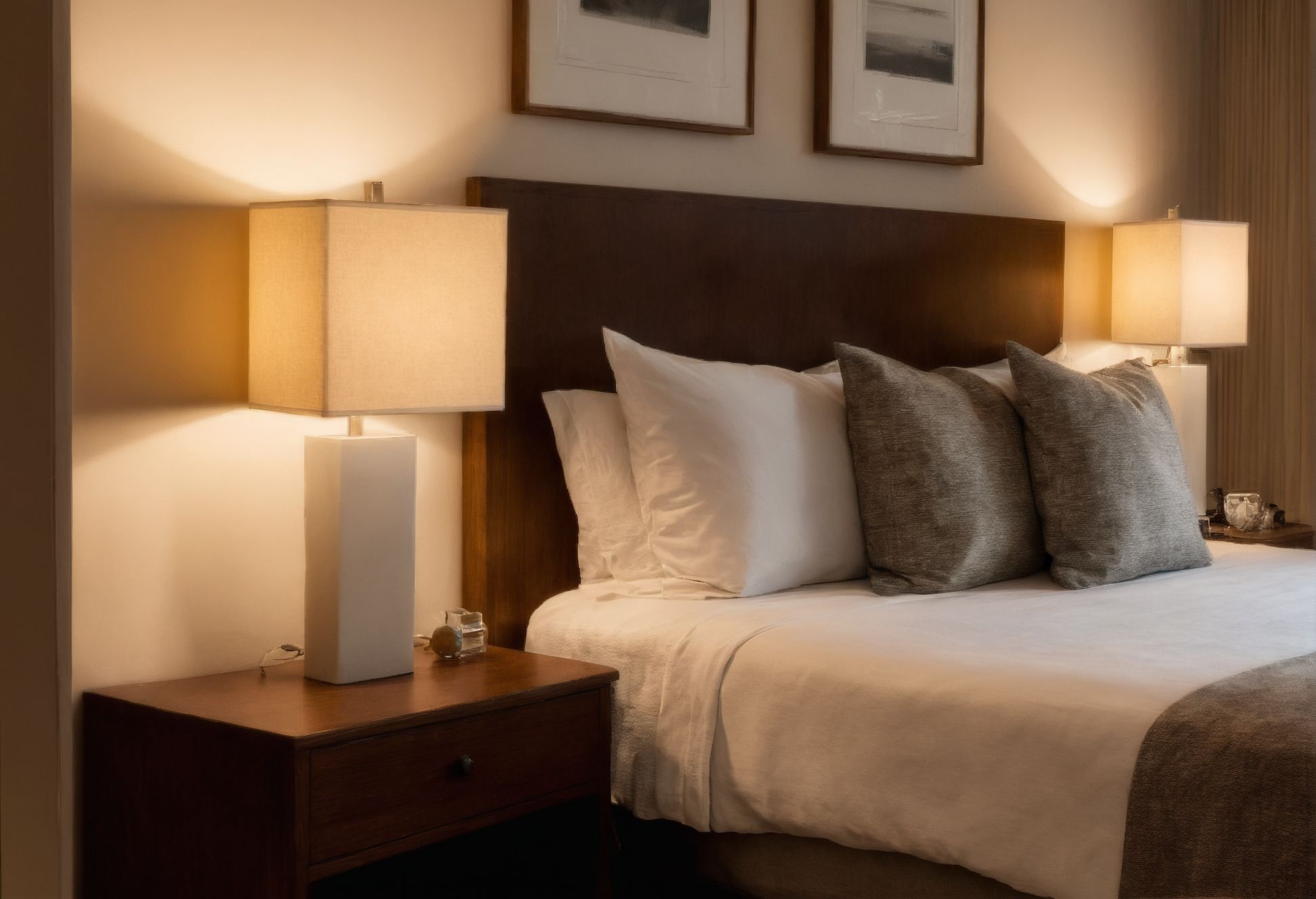
Guests judge a hotel room's lighting twice: in the first minute and again at two in the morning. On arrival they want to see the room at once; at night they want to reach the bathroom without waking a partner or fumbling along the wall. A good scheme serves both moments by layering several light sources and giving each one a control the guest can find without a manual.
This article covers the layers a guest room needs, where switches belong, how to keep controls usable for everyone, and why evening and night light should stay low.
Which lighting layers does a guest room need?
A guest room usually needs five layers: general light, task light at the desk and the bed, grooming light at the mirror, accent or ambient light for the evening, and a low night light along the route to the bathroom. Each layer exists for a specific activity, so each should be controllable on its own.
General light lets a guest arrive, unpack and find things. It can come from ceiling fixtures, a cove, or a few lamps switched together, but it should light the floor and the luggage area evenly.
Task light is directional and close: a reading light on each side of the bed that does not spill onto the other pillow, and a desk lamp that lights the work surface rather than the screen.
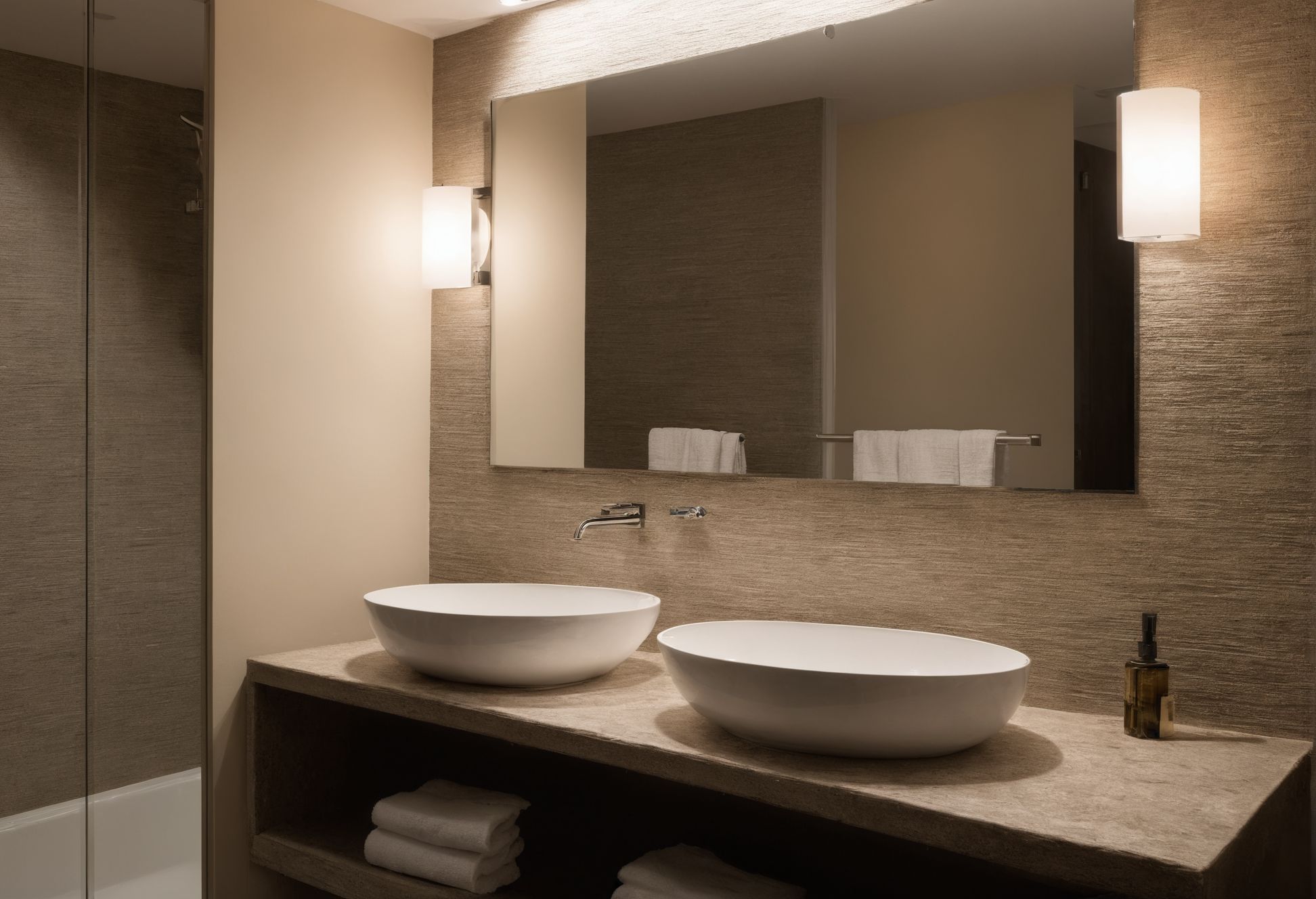
Grooming light at the mirror should light the face from the front and sides. A single downlight above the mirror leaves shadows under the eyes and chin.
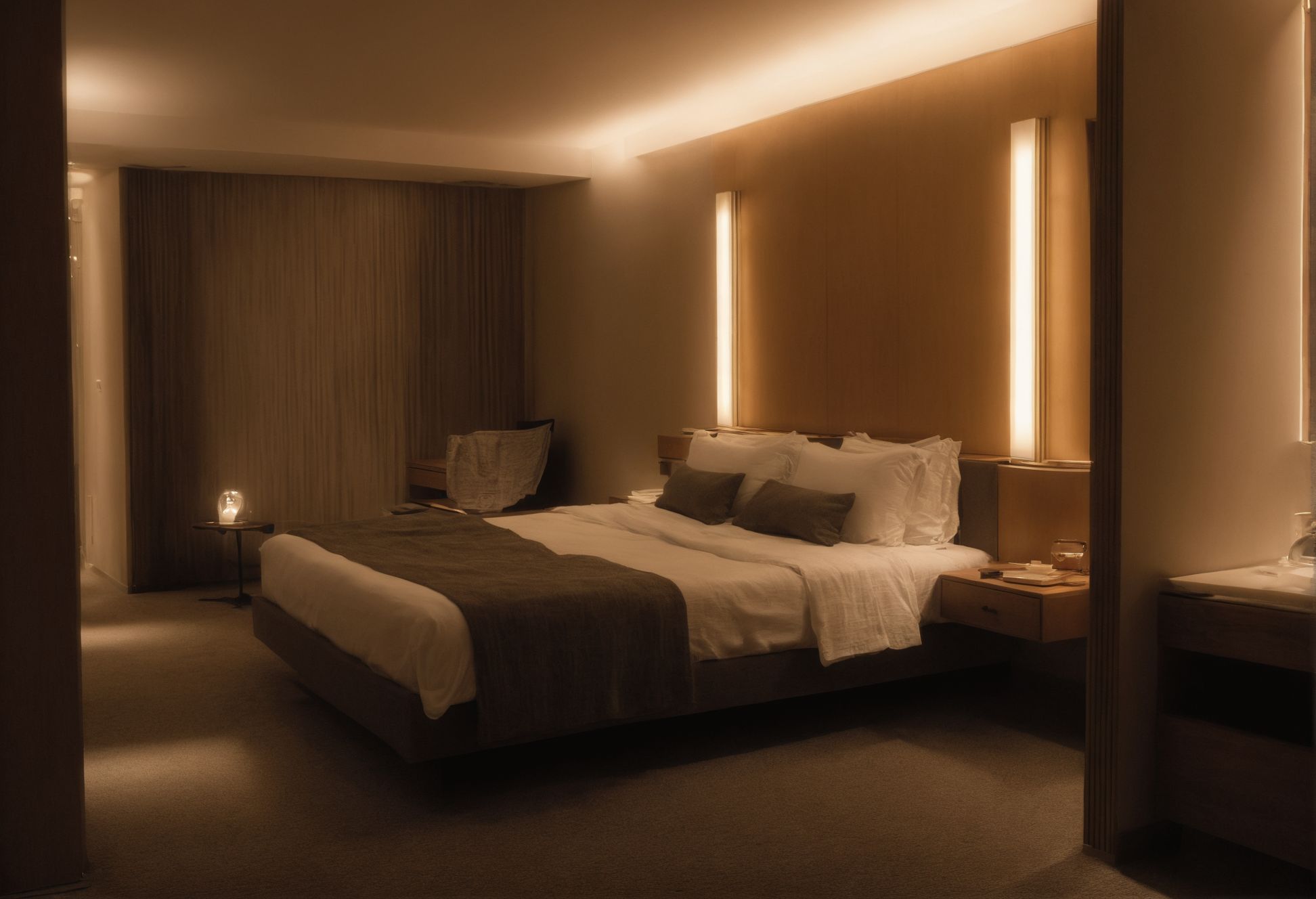
Ambient light is the warm, low layer used in the evening: a cove, a floor lamp or a lit niche. It makes the room feel finished when the general light is off.
Night light is a very low glow at floor level along the route from bed to bathroom and in the bathroom itself. It should be enough to walk by and not enough to wake anyone.
Where should the switches be?
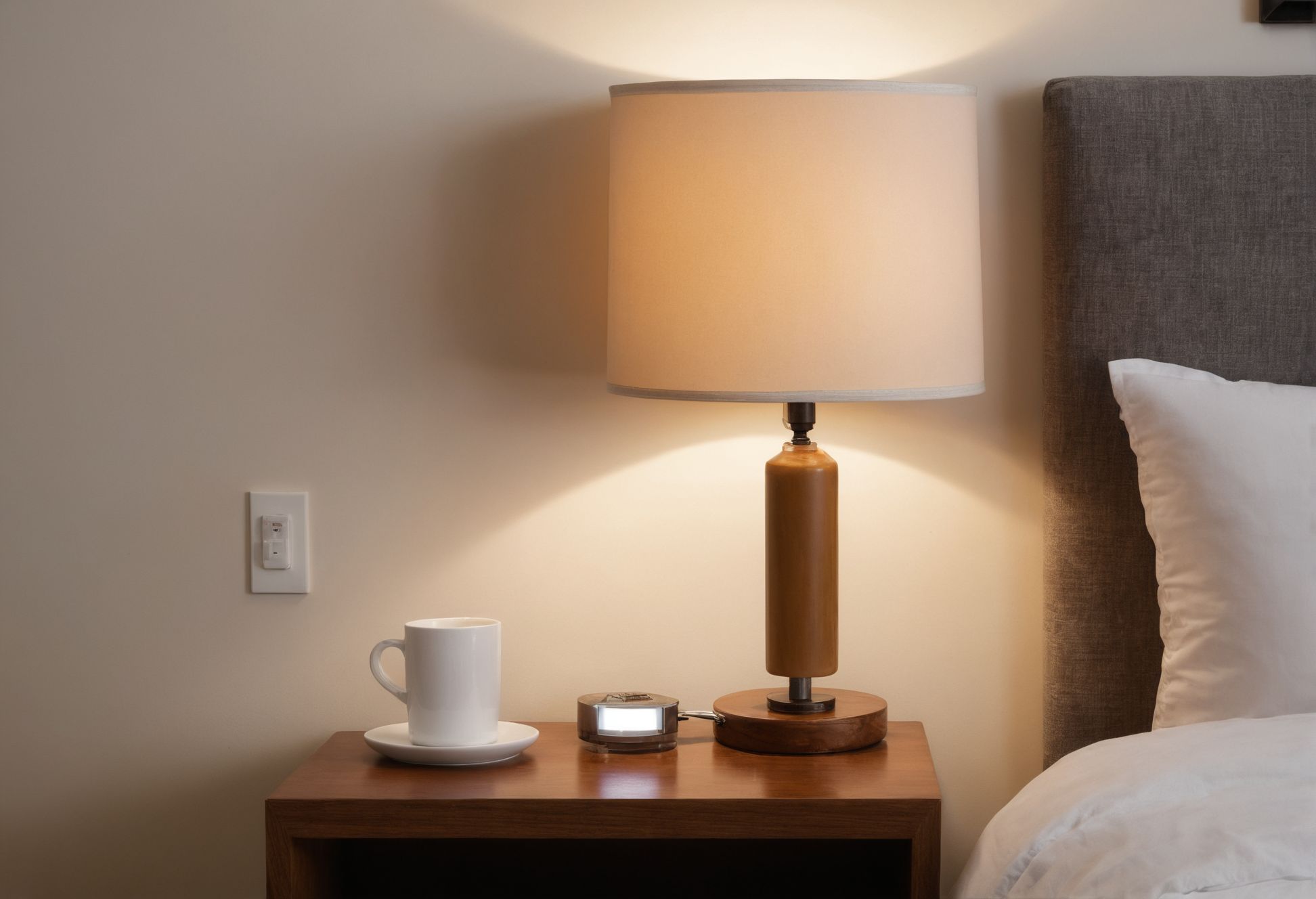
Put controls where people reach for them: a master control just inside the door and a second one at the bed. The door control should turn on a welcome scene for arrival and turn everything off on departure. The bed control should turn off all room lights, operate each reading light separately and switch the night light.
The usual failure looks like this: one switch per fixture, spread around the room, unlabeled, and nothing at the bed that turns the whole room off. A guest then crosses the room in the dark to switch off a lamp they cannot find. The U.S. National Institute on Aging's room-by-room fall prevention advice recommends night lights and light switches close to the bed, light switches at each end of a long hall, and a light left on in the bathroom or a night light that turns on automatically in the dark. Its advice is written for homes, but the same logic applies to an unfamiliar hotel room at night, where the guest does not know where the furniture is.
Label controls with words or clear symbols that read in low light. If the scheme uses scenes, keep them few and name them after what the guest is doing, such as "Room", "Reading" and "Night", rather than numbering them.
How do controls stay usable for every guest?
Controls must be reachable and easy to operate. In the United States, the 2010 ADA Standards for Accessible Design require operable parts to be within the reach ranges in section 308; for an unobstructed forward reach, that is no higher than 48 inches and no lower than 15 inches above the floor (section 308.2.1). Operable parts must work with one hand, without tight grasping, pinching or twisting of the wrist, and need no more than 5 pounds of force (section 309.4).
Those rules favor large rocker switches and push buttons over small toggles and rotary dimmers. Touch panels need clear tactile or visual feedback, and they should not fail into a state where the lights cannot be turned on. Bedside controls should be reachable from the bed, not only from a standing position beside it.
Rooms designed for guests with hearing loss add another lighting job. The ADA Standards require guest rooms with communication features to have visible notification devices that alert occupants to incoming telephone calls and to a door knock or bell, and these must not be connected to the visible alarm signal appliances (section 806.3.2). Coordinate these devices with the lighting design so that they are visible from the bed and the bathroom and are not confused with decorative light.
Why should evening light stay low?
Bright light late in the evening works against sleep. In a study of 116 healthy adults published in the Journal of Clinical Endocrinology and Metabolism, Gooley and colleagues compared ordinary room light (below 200 lux) with dim light (below 3 lux) in the eight hours before bedtime. Room light suppressed the sleep-related hormone melatonin, delayed its onset in 99 percent of participants and shortened its duration by about 90 minutes. Room light during the usual hours of sleep suppressed melatonin by more than 50 percent in most trials.
The study was carried out in a research setting with young adults, not in hotels, so it does not give a hotel design target. It does support a simple design principle: the evening scene should be noticeably dimmer than the arrival scene, and the night light should be far dimmer still. Low-level ambient and night light, warm sources and the ability to switch off every general fixture from the bed all follow from it.
Blackout is part of the same scheme. Curtain or blind tracks that leave a bright gap at the edges, standby LEDs on televisions and chargers, and light under the corridor door can all add light at night. Check them in a mock-up room with the lights off.
How should glare and color be handled?
Glare is the most common complaint that lighting drawings do not show. A bare downlight above the bed, a reading light that shines into the eyes of the person lying next to it, or a bright lamp reflected in the television screen can spoil a well-planned room. Check sight lines from the pillow, the desk chair and the armchair, and choose shielded or diffused fixtures wherever a guest's eye can see the source directly.
Color consistency matters as much as brightness. A room lit by lamps of different color temperatures or different color rendering looks unfinished, and finishes chosen under one light can look wrong under another. Specify the color temperature and color rendering for each layer, approve the finishes under the specified lamps in the mock-up room, and require the same values for replacements. Dimming should be smooth and flicker-free across its whole range, which depends on the combination of lamp, driver and dimmer, so test that combination rather than each part alone.
How do you test a guest-room lighting scheme?
Test it in a mock-up room, at night, as a guest would use it. Arrive with luggage and see whether the door control lights the floor and the luggage rack. Read in bed with a second person trying to sleep. Get up in the dark and walk to the bathroom using only the night light. Shave or apply make-up at the mirror. Then try the controls seated and with one hand.
Record what each fixture is for, which control operates it, and which lamp or module it uses. Maintenance staff need that schedule as much as designers do: a replaced lamp with a different color or brightness can spoil a carefully balanced room. Keep spare lamps and modules from the specified range, and check the scenes again after any change to the controls or their firmware.